
The Best States to Form an LLC

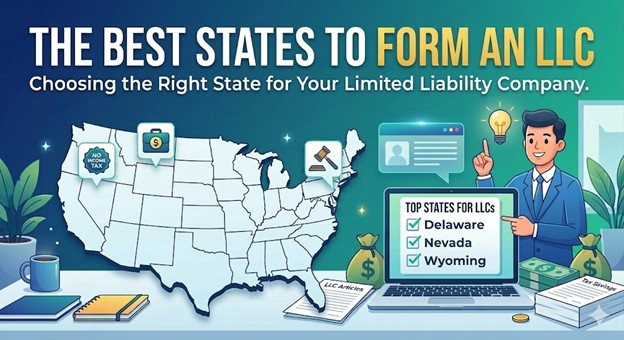 When choosing the best state to form an LLC, most guidance points to your home state. That advice is practical for many small businesses, but Delaware consistently stands apart as a top choice for entrepreneurs who want flexibility, credibility, and long-term growth potential. Let’s take a look at a few scenarios where Delaware makes sense and why it remains the gold standard for LLC formation.
When Delaware Is the Best Choice
Forming in your home state is often the simplest option. But Delaware becomes the better choice if you:
- Plan to grow or raise outside investment
- Want a business-friendly legal environment
- Prefer flexible ownership and management structures
- Value privacy and streamlined compliance
Keep in mind that Delaware is not just for large corporations. It can also benefit early-stage founders who want to build with scale in mind. Even if you start small, forming an LLC in Delaware can position your business for future growth.
What Makes Delaware Different?
Delaware has built a reputation as the most business-friendly state in the U.S., and rest assured, this is not marketing language. It is backed by decades of legal and regulatory consistency. Here are a few key advantages of forming a Delaware LLC:
- Predictable and Established Business Law
Delaware’s Court of Chancery focuses exclusively on business cases. This means disputes are resolved quickly and with clear precedent.
- Flexible LLC Structure
Delaware allows LLC owners to customize how the company is run. You can define ownership, voting rights, and profit distribution in ways that fit your business model.
- Strong Confidential Protections
Delaware does not require LLC members or managers to be publicly listed in formation documents. This is appealing for founders who prefer discretion.
- No State Income Tax on Out-of-State Activity
If your LLC operates outside Delaware, the state does not tax that income. This can be beneficial for certain business models, especially online or multi-state operations.
- Widely Recognized by Investors
Many venture capital firms prefer or require Delaware entities. Forming in Delaware early can save time if you plan to raise funding later.
How Delaware Compares to Other States
Other states, like Wyoming and Nevada, are also promoted for low fees or tax benefits, which can be appealing. Let’s take a look at how Delaware compares in practical terms:
- Wyoming: Lower costs in Wyoming, but less established legal precedent
- Nevada: Similar tax benefits, but higher fees and less adoption by investors
- Your home state: Simpler compliance locally, but fewer structural advantages
The key difference is not just cost. It is the long-term value of operating within a well-established business framework.
Understanding “Doing Business” Requirements
One important factor to consider is where your business actually operates. If you form a Delaware LLC but run your business in another state, you may need to register there as a foreign entity. This adds additional filing fees, ongoing compliance in two states, and a registered agent requirement in each state. That said, many businesses still choose Delaware despite this because of its legal and structural advantages.
Getting Started with a Delaware LLC
Forming a Delaware LLC is straightforward, especially with the right support. Harvard Business Services, Inc. has helped form hundreds of thousands of Delaware LLCs and offers reliable registered agent services at a competitive price. Our experience makes it easier to stay compliant and focused on building your business.
Just remember that the best state to form an LLC depends on your goals. For many small, local businesses, their home state is a perfectly acceptable choice. However, for entrepreneurs thinking about long-term growth and flexibility, Delaware offers clear advantages.
FAQs
Is Delaware worth it for a small business?
It can be, especially if you plan to grow, operate online, or want flexible ownership structures. For purely local businesses, the home state may still be simpler. However, Delaware is almost always worthwhile for businesses with complex, multi-state legal needs.
Do I need to live in Delaware to form an LLC there?
No. You do not need to live in Delaware to form an LLC there. You can live in any state or country. However, you must appoint a Registered Agent with a physical street address in Delaware to receive legal documents on your behalf.
Do Delaware LLCs have lower taxes?
Not automatically. While Delaware has no state income tax for LLCs that don't do business there, you still pay a flat $400 annual franchise tax.
*Disclaimer*: Harvard Business Services, Inc. is neither a law firm nor an accounting firm and, even in cases where the author is an attorney, or a tax professional, nothing in this article constitutes legal or tax advice. This article provides general commentary on, and analysis of, the subject addressed. We strongly advise that you consult an attorney or tax professional to receive legal or tax guidance tailored to your specific circumstances. Any action taken or not taken based on this article is at your own risk. If an article cites or provides a link to third-party sources or websites, Harvard Business Services, Inc. is not responsible for and makes no representations regarding such source’s content or accuracy. Opinions expressed in this article do not necessarily reflect those of Harvard Business Services, Inc.