
Beginner's Guide to Starting a Corporation in Delaware

 Starting a corporation is a major step for founders who want a formal business that can grow exponentially. A corporation is a separate legal entity from its shareholders, which makes it useful for raising capital and adding investors.
Delaware is a popular state for incorporation because it has a well-developed body of corporate law, a business-focused court system, and a formation process that’s preferred by investors, attorneys, and business service providers. The Delaware Division of Corporations describes Delaware as a leading domicile for U.S. and international business entities.
Should You Start a Corporation?
A corporation is not the only option. Many small businesses choose to form an LLC because it’s flexible and generally has fewer internal formalities. A corporation may be the better fit when the business needs stock, shareholders, a board of directors, or a structure that supports outside investment.
Nevertheless, for many growth-focused founders, starting a Delaware corporation makes sense because the structure is widely recognized and can support fundraising.
Steps for Starting a Corporation in Delaware
The process begins with a few key decisions. Delaware provides official corporation forms and certificates through the Division of Corporations, including forms for stock corporations, non-stock corporations, public benefit corporations, amendments, dissolutions, and related filings.
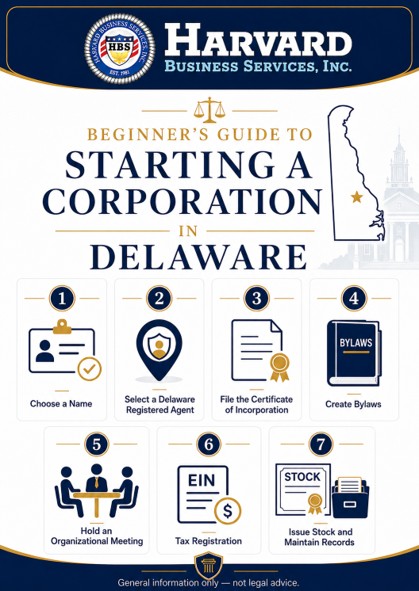
A typical formation checklist includes:
- Choose a name. The name must be distinguishable from other Delaware entities and usually include a corporate ending such as “Inc.,” “Corporation,” or “Company.”
- Select a Delaware registered agent. Delaware law requires every business entity to maintain a registered agent in Delaware.
- File the Certificate of Incorporation. This document creates the corporation and generally includes the company name, registered agent, authorized shares, and incorporator information.
- Create bylaws. Bylaws explain how the corporation operates, including director roles, voting procedures, and rules for recordkeeping.
- Hold an organizational meeting. The initial directors typically approve bylaws, appoint officers, authorize stock issuance, and document early company actions.
- Tax registration. Applying for a tax ID is necessary to open a business bank account, hire employees, and manage federal tax filings.
- Issue stock and maintain records. Corporations should keep accurate records of meeting minutes and stock issuance.
C Corporation, S Corporation, and Taxes
A Delaware corporation is formed under state law, but its federal tax treatment is a separate matter. Many corporations are taxed as C corporations by default. Some eligible corporations elect S corporation status for federal tax purposes. To become an S corporation, the IRS states that a corporation must submit Form 2553, Election by a Small Business Corporation, signed by all shareholders. This election has eligibility rules, so founders often review it with a tax professional before filing.
Incorporate your business the easy way!
Let us help you figure out the right type of corporation for your business and guide you through the process.
Create my corporation

Delaware Franchise Tax and Annual Compliance
After formation, a Delaware corporation must stay in good standing. Delaware requires corporations incorporated in the state to file an Annual Report and pay a franchise tax. Exempt domestic corporations do not pay franchise tax, but they still must file an Annual Report.
Federal reporting rules should also be monitored. FinCEN currently states that entities created in the United States, including entities previously known as domestic reporting companies, are exempt from BOI reporting under the Corporate Transparency Act.
Start Your Delaware Corporation with Confidence
Starting a corporation requires more than submitting one form. Founders need the right structure, a Delaware registered agent, a properly filed Certificate of Incorporation, internal governance documents, and a plan for annual compliance.
Harvard Business Services, Inc. helps entrepreneurs form Delaware corporations and maintain them with dependable registered agent service, mail forwarding, Certificates of Good Standing, foreign qualification support, and related compliance solutions. For founders ready to form a Delaware corporation, HBS provides a clear path from formation to ongoing maintenance.
FAQs
Do I need to live in Delaware to start a Delaware corporation?
No. Many Delaware corporations are formed by owners who live or operate outside Delaware. The corporation must, however, maintain a Delaware registered agent.
Is a Delaware corporation always a C corporation?
No. “Delaware corporation” refers to the state of formation. “C corporation” refers to federal tax treatment. Some eligible corporations may elect S corporation status with the IRS.
What happens after I form a Delaware corporation?
You should adopt bylaws, appoint officers, issue stock, file required annual reports, and pay your Delaware franchise taxes while maintaining accurate records for your business.
*Disclaimer*: Harvard Business Services, Inc. is neither a law firm nor an accounting firm and, even in cases where the author is an attorney, or a tax professional, nothing in this article constitutes legal or tax advice. This article provides general commentary on, and analysis of, the subject addressed. We strongly advise that you consult an attorney or tax professional to receive legal or tax guidance tailored to your specific circumstances. Any action taken or not taken based on this article is at your own risk. If an article cites or provides a link to third-party sources or websites, Harvard Business Services, Inc. is not responsible for and makes no representations regarding such source’s content or accuracy. Opinions expressed in this article do not necessarily reflect those of Harvard Business Services, Inc.