
Delaware LLC vs Corporation
Are you ready to start a Delaware business, but are unsure which entity type is best for you? Our team at Harvard Business Services, Inc. will help you choose between the LLC and the corporation.

Start your business with Harvard!
LLC vs Corporation
Before choosing to form an LLC or a corporation, be sure to consider a few of the following differences:
- Management structures
- Privacy
- Liability
- Opportunities for raising capital
- Tax structures
- Formation processes
Below, you can learn more about each to help you decide whether a corporation or LLC is right for you.
1. Management
The principal difference between a corporation and an LLC is the governance structure.
Governance for Corporations
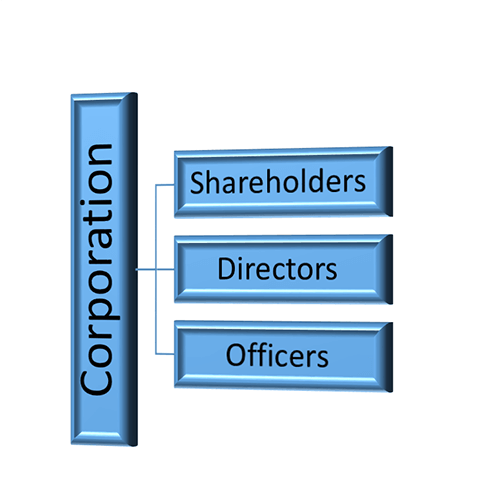
A corporation is structured with three tiers of power: Shareholders, Directors, and Officers. This structure is prescribed by Delaware Corporation Law and cannot be changed. The duties of each tier, and the relationship between them, are also designed by Delaware law.
The shareholders are the owners of the company; they invest money by purchasing stock, thus becoming owners. Once shareholders buy stock, they become entitled to two specific rights: 1) one vote per share in stockholder votes; and 2) their pro rata share of the dividends when the Board of Directors declares a distribution of profits in the form of shareholder dividends.
Governance for LLCs
An LLC is governed by a contract between all the members, called an Operating Agreement. The Operating Agreement is binding on all signatories, and all members of the LLC must sign it. Some of the specific issues an LLC's Operating Agreement may determine are:
- Member interests
- LLC interests
- Capital accounts
- Management rights and responsibilities
- Contributions to the company (financial or otherwise)
- Allocation of profits and losses
- Distributions
- Liquidation rights, procedures and distributions
- Fiduciary duty
- Dissolution procedures
An LLC can customize its own operating agreement, or can use an LLC Operating Agreement Template to speed up the process.
An LLC's default structure consists of several members and one manager. The members may manage the company themselves, or they may hire an external manager.
The organizational formalities of an LLC are much more casual than in a corporation; there is no Board of Directors in an LLC, thus no Board of Directors meetings. LLC members (owners) do not need to hold regular meetings and therefore don't need to record meeting minutes or submit state annual reports.
2. Privacy
The next significant difference between a Delaware corporation and an LLC is privacy.
Privacy for Corporations
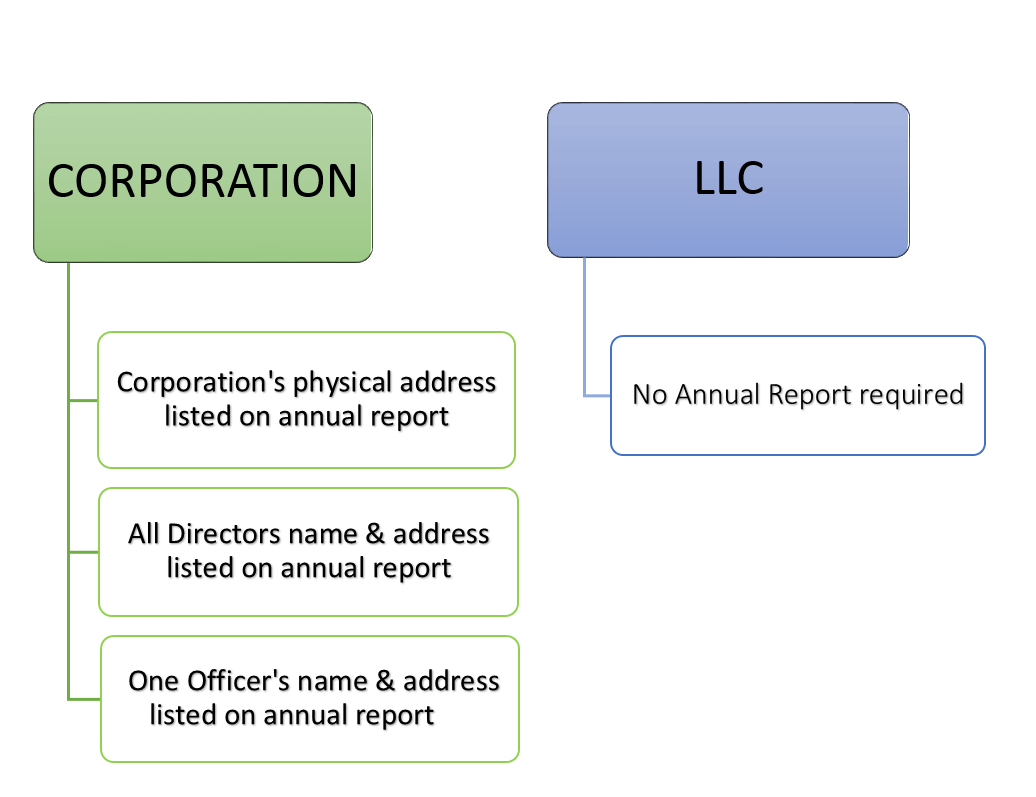
A Delaware corporation's annual report must state the name and physical address of all the Directors, the name and physical address of one officer, and the physical address of the corporation's principal place of business.
Privacy for LLCs
In contrast, the state of Delaware requires very little information in order to file an LLC; in fact, it does not require the personal names and addresses of the members/managers, and doesn't need to submit an annual report to the state of Delaware. Therefore, none of your info will exist on the public record.
All the state requires is that the LLC's Registered Agent possesses the name and address of a Communications Contact, who can be a member/manager of the LLC or merely a representative, such as the company's attorney.
Under normal circumstances, it is difficult to obtain the LLC's members' names, as they are not required to be disclosed, but if required by law, Registered Agents are obligated to disclose any and all information on record, as well as all transactions with the LLC and its founders, members, and representatives.
Delaware LLCs and corporations are similar in that both require state filing upon formation; both exist perpetually unless otherwise specified; and both entities shield their members/shareholders from personal liability.
3. Liability
Another thing to consider when choosing between an LLC and a corporation is the burden of liability.
Both corporations and the limited liability company (LLC) offer liability protection to their owners. Generally, aside from what's already been invested in the corporation, shareholders' personal assets are protected from the debts, liabilities, and legal obligations of the corporation. Similarly, with an LLC, members are typically not held liable beyond their investment in the company.
Still, regardless of entity type, liability protection is not absolute. Courts may “pierce the corporate veil” if owners mix personal and business finances, fail to maintain proper records, or ignore required corporate formalities.
In practice, both Delaware LLCs and corporations can provide strong liability protection when properly maintained.
4. Raising Capital
Delaware corporations generally have a significant advantage over Delaware LLCs when it comes to raising outside capital. While both entity types can accept investment, corporations are typically structured in a way that investors find more familiar, scalable, and legally predictable.
Most venture-backed startups choose a Delaware C corporation because corporations can easily issue common and preferred stock. Delaware corporate law is also highly developed, giving investors confidence in shareholder rights and dispute resolution through the Delaware Court of Chancery.
Delaware LLCs, by contrast, are often better suited for smaller businesses. LLCs can raise capital by issuing membership interests, but the process is usually less standardized than corporate equity financing. As a result, many startups begin as LLCs for simplicity, then convert into Delaware corporations before seeking venture capital funding. Still, for companies planning rapid growth, equity fundraising, or a future acquisition, a Delaware corporation is usually the preferred structure.
5. Taxation
The last substantial difference between incorporating and forming an LLC is federal taxation.
Taxation for Corporations
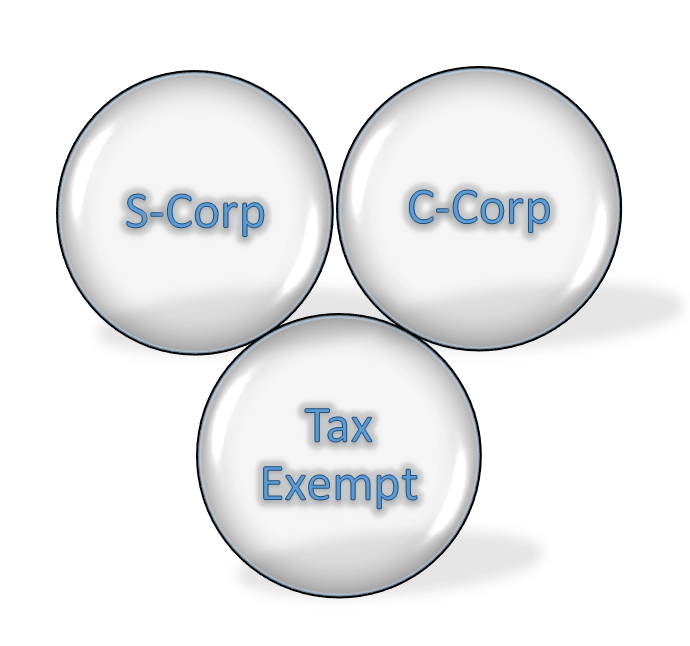
Those forming a corporation can choose one of three IRS taxation options: C corporation, S corporation, or non-profit.
C Corporations
The default classification is called a C corporation. This type of company pays taxes on its profits each year and may choose to distribute dividends to its shareholders.
When shareholders receive a dividend, they pay individual tax on the money. If the shareholders are a small, tight-knit group, this is often referred to as double taxation.
S Corporations
An S corporation is a tax status for a C corporation. An S corporation offers limited liability protection to its shareholders, meaning their personal assets will be protected from litigation and business expenses. However, S corporations eliminate double taxation.
In order to avoid double taxation, a corporation with fewer than 100 shareholders can elect Subchapter S tax status by filing IRS Form 2253 within 75 days of its formation date, or in subsequent tax years.
A subchapter S company is often referred to as an "S corporation." Under this form of taxation, the entity does not pay taxes to the federal government. Instead, the tax liability on the profits and losses of the company is "passed through" to the shareholders of the company in their pro-rata share of the company. Then, the shareholders must pay the taxes.
Please note: non-U.S. citizens cannot apply for S corporation status.
Tax Exempt / Non-Profit
The third taxation option for a corporation is tax-exempt status, which turns the corporation into a non-profit company. To gain tax-exempt status, the company must file IRS Form 1023 and qualify for tax-exempt status by engaging in a qualifying charitable, religious, or public service purpose.
Taxation for LLCs
Tax classification for an LLC is initially gained by filing an application for an Employer Identification Number or EIN (also called a Federal Tax ID Number). Typically, for tax purposes, the IRS considers a single-member LLC a disregarded entity and a multi-member LLC a partnership.
To change the Entity Classification Election to a C-Corp for federal tax purposes, the company needs to file IRS Form 8832. To change the classification to an S-Corp, the company needs to file IRS Form 8832 and, simultaneously, IRS Form 2553.
Before you decide to create an LLC, learn more about the different options for Delaware LLC Tax Status to decide which option is best for your company.
6. Formation Processes
When forming a new Delaware business, both entity types must register with the Delaware Division of Corporations and maintain a registered agent with a physical address in Delaware.
Forming an LLC
To form a Delaware LLC, owners file a Certificate of Formation and typically create an Operating Agreement outlining ownership, management structure, voting rights, and profit distribution. Delaware does not require the Operating Agreement to be filed publicly, giving LLCs additional flexibility and privacy.
Forming a Corporation
To form a Delaware corporation, founders file a Certificate of Incorporation that includes details such as authorized shares, registered agent information, and some ownership details. Corporations also generally require more organizational steps after formation, including:
- Appointing a board of directors
- Adopting corporate bylaws
- Issuing stock certificates or shares
- Holding initial board meetings
- Maintaining corporate minutes and records
Frequently Asked Questions
Yes. An LLC can elect to be taxed as either a C corporation or an S corporation by filing the appropriate IRS forms. Many business owners choose S corporation taxation to reduce self-employment taxes while keeping the legal flexibility and liability protection of an LLC structure.
No. You do not need to live in Delaware or operate your business there to form a Delaware LLC or corporation. However, you must maintain a registered agent with a physical Delaware address, and you may still need to register your company in your home state as a foreign entity.
The limited liability company (LLC) is often the preferred choice for a small business because of its flexibility. LLCs have fewer formalities and don't require as much reporting, making the process easier for new business owners. On the other hand, corporations have shares of stock that can be sold, and requirements such as holding annual meetings and formal minutes for record keeping. So, unless your business plans to seek investors or growth in the long term, then generally the LLC is the better choice.
Yes. Many startups initially form as LLCs for tax flexibility and simplicity, then convert into Delaware C corporations before raising venture capital.
Infographic: LLC vs. Corporation
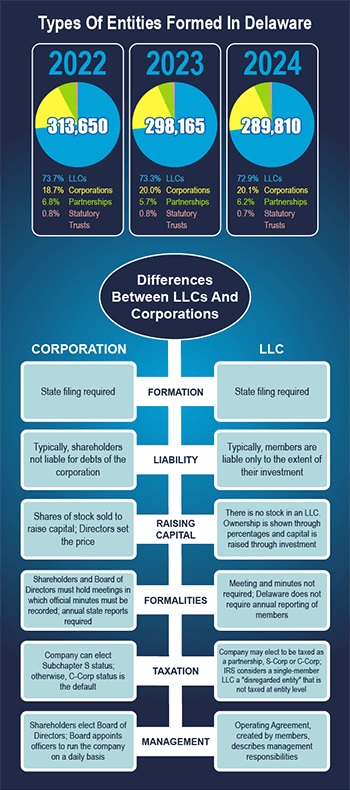 Here, you can find our quick-reference infographic on the differences between an LLC and a corporation. This visual provides statistics and a quick recap of key differences, such as:
- Liability
- Raising Capital
- Formalities
- Taxation
- Management
So, LLC or corporation, which is best for you? Be sure to read more about the Benefits of a Delaware LLC and the Benefits of a Delaware Corporation to help get a better understanding of these two types of entities. If you would like more information on either a Delaware corporation or LLC, please feel free to contact the experienced business formation specialists here at Harvard Business Services, Inc. You can contact us via live chat, telephone (800-345-2677), or email.
If you are ready to form a Delaware corporation or LLC, it's easy to do so with our online order form. Our helpful staff can assist you at any point with any questions you may have.
More From The Learning Center
Find the answers to all your business questions!
- Why Incorporate in Delaware?
- How to Incorporate in Delaware
- 5 Simple Steps to Form a Company
- How to Choose a Company Name
- How to File a Corporation or LLC in Delaware
- Avoiding Hidden Incorporation Fees
- Delaware Company Formations for Non-Residents
- Understanding Your Company's Stock
- What Is a Delaware Registered Agent?
- Delaware Company Formation Packages
- 3-Step Business Formation Checklist (PDF)
- What Is a Delaware LLC?
- What Is a General Corporation?
- Why Form a Delaware Corporation?
- What Is a Close Corporation?
- What Is a C Corporation?
- What Is a Delaware S Corporation?
- What Is a Non-Profit Corporation?
- What Is a Public Benefit Corporation?
- Corporation vs LLC
- What Is a Limited Partnership?
- The Delaware Series LLC
- S Corporation Tax Status for Your LLC
- Compare Business Entities
- Why Form a Delaware LLC?
- What is a Delaware Limited Liability Company (LLC)?
- Advantages of a Delaware LLC
- Which LLC Operating Agreement Is Right for You?
- About Delaware LLC Fees
- Delaware LLC Formation Requirements
- Guidelines for Naming a Delaware LLC
- The Best Registered Agent for a Delaware LLC
- What Does "Limited Liability" in a Delaware LLC Mean?
- Differences Between an LLC and an LP
- History of Delaware LLC
- Cancellation Process for a Delaware LLC
- Asset Protection for Airplane Owners
- Asset Protection for Boat Owners
- Asset Protection for Consultants
- Asset Protection for General Contractors
- Asset Protection for Non-Resident Aliens
- Asset Protection for Real Estate Investors
- Asset Protection for School Bus Drivers
- Asset Protection for Students
- Asset Protection for Trucking LLCs
- Complete List of Asset Protection Planning