
Can You Have Multiple Businesses Under One LLC?


Sometimes, forming one business just isn’t enough. When you have several amazing business ideas that can change the world, you might be tempted to form several LLCs at the same time. However, as you pursue the path of business ownership, several questions may arise. What type of business activity can I conduct with my LLC? How many different businesses can I operate under one LLC? Will a Series LLC work for me?
Depending on the scope of your individual businesses, the answers to your questions may vary. Operating multiple businesses under a single LLC is an option, but you may also want to consider a few alternatives. First, let’s review the basics.
Can You Operate Multiple Businesses Under One LLC?
Yes, you can operate multiple businesses under one LLC. This setup allows all business activities to be managed under a single legal entity, which can simplify administration and reduce formation costs. However, it’s important to understand that all operations under the LLC share the same legal and financial liability, meaning if one business faces a lawsuit or debt, the others could be affected.
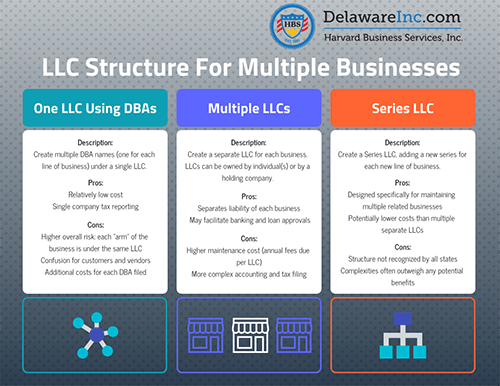
To manage multiple businesses under one LLC, you generally have three options:
Take the first step to being your own boss!
We make it quick and easy to form your Delaware LLC.
Start my business
Multiple DBAs Under One LLC
One common way to run multiple businesses under one LLC is by registering multiple DBAs, or “doing business as” names. A DBA allows your LLC to operate under a different business name without creating a separate legal entity. This is a great choice if your businesses are related or share the same ownership. It may also be simpler and less expensive than forming a separate LLC for each business. However, it is important to understand that a DBA does not provide separate liability protection. All DBAs still belong to the same LLC, which means all of your assets are legally connected. If one DBA faces a lawsuit or debt, the entire LLC could be affected.
- Formation - The business owner forms one LLC and registers one or more DBA names for the different brands.
- Liability - All DBAs operate under the same LLC, so they generally share the same legal risk.
- Tax Treatment - DBAs are not separate legal entities, so they are usually taxed as part of the same LLC.
Separate LLCs for Separate Businesses
Another option is to form a separate LLC for each business you operate. Instead of running multiple brands under one legal entity, each business has its own LLC, bank account, contracts, tax records, and liability protection. This structure can be especially helpful when the businesses are mostly unrelated. The biggest advantage is legal separation. If one LLC faces a lawsuit, the other LLCs are better protected. However, separate LLCs also come with more administrative work, including additional formation fees, annual reports, and compliance requirements. For many business owners, the decision comes down to balancing simplicity against stronger liability separation.
- Formation - The business owner forms a separate LLC for each business, with each entity having its own formation documents & fees.
- Liability - Each LLC has its own legal protection from the others.
- Tax Treatment - Each LLC is usually treated as its own tax entity.
Series LLC
A Series LLC is a special type of LLC that allows one parent LLC to create separate internal divisions, called series. Each series can have its own assets, business purpose, and liability protection. This structure offers some of the liability separation of multiple LLCs while reducing the need to form and maintain several separate entities. The one caveat is that Series LLCs are more complex than standard LLCs and are not available in every state. Banks and courts may also handle them differently depending on the jurisdiction.
- Formation - The business owner forms one Series LLC and then creates individual series under the parent LLC.
- Liability - Each series may have separate liability protection from the others (can vary by state).
- Tax Treatment - Each series needs separate accounting and may be treated separately for tax purposes (can vary by state).
Choosing a Solution
Choosing between multiple DBAs under one LLC, separate LLCs for separate businesses, and a Series LLC depends on your goals for your businesses. A simpler setup may work well for closely related or low-risk businesses, while separate entities may be better for businesses with different assets. Before deciding, consider how each option affects legal protection, taxes, costs, and future growth.
- Are the businesses closely related, or are they completely different?
- Does one business carry more legal or financial risk than the others?
- Would a lawsuit against one business put the others at risk?
- Will each business use a different name or brand?
- Will each business have a different customer base?
- Will the businesses have the same owners or investors?
- Will each business have its own bank account and financial records?
- Are you comfortable managing multiple compliance deadlines?
- Does your state allow Series LLCs?
FAQs
How many DBAs can an LLC have?
An LLC can technically have any number of DBAs under its umbrella. As long as each DBA is registered separately with the Delaware Division of Corporations and you pay a filing fee for each name, you can continue to add new DBAs.
Can two unrelated businesses be under one LLC?
Yes, but it may not always be the best choice. The main benefit is simplicity, as you only have one legal entity to form and maintain. However, the biggest downside is shared liability. If one business is sued or takes on debt, the other business could be affected because both are part of the same LLC. It could also be confusing for customers who are trying to research your business.
Can I add a new business to my existing LLC?
Yes, you can add new businesses to an LLC. You may also need to register a DBA if the new business will use a different public-facing name. If the new business is very different or higher-risk, forming a separate LLC may be better.
What states allow Series LLCs?
There are currently over a dozen different states that allow you to form a Series LLC. Delaware does allow them, and was even the first state to introduce the Series LLC structure back in 1996. Other states include Illinois, Texas, Nevada, and Wisconsin.
Can an LLC own another LLC?
Yes, an LLC can own another LLC. Such cases are referred to as a parent-subsidiary relationship, where the parent LLC holds ownership in a subsidiary LLC. In these scenarios, the parent will have control of the subsidiary’s operations while remaining a separate legal entity.
Next: How to Create and Use a DBA
Take the first step to being your own boss!
We make it quick and easy to form your Delaware LLC.
Start my business*Disclaimer*: Harvard Business Services, Inc. is neither a law firm nor an accounting firm and, even in cases where the author is an attorney, or a tax professional, nothing in this article constitutes legal or tax advice. This article provides general commentary on, and analysis of, the subject addressed. We strongly advise that you consult an attorney or tax professional to receive legal or tax guidance tailored to your specific circumstances. Any action taken or not taken based on this article is at your own risk. If an article cites or provides a link to third-party sources or websites, Harvard Business Services, Inc. is not responsible for and makes no representations regarding such source’s content or accuracy. Opinions expressed in this article do not necessarily reflect those of Harvard Business Services, Inc.
More By Rick Bell
![]()
Email this article to a friend
There are 27 comments left for Can You Have Multiple Businesses Under One LLC?
Mokgohlwa said: Monday, March 12, 2018Hi, what is the procedure of combining two or three different businesses?
HBS Staff replied: Monday, March 12, 2018Typically, a DBA is set up with the state and/or county that you are operating out of. Before setting up the DBA, your home jurisdiction may require you to foreign qualify there, if you have not done so already. We are not able to file the DBA, but we are more than happy to assist with the foreign qualification.
Your business is considered domestic to the state where formed, and foreign in all other States. To take advantage of the strong corporate law structure, Delaware is by far the most popular domestic choice.
If your business will have a physical presence by operating, hiring employees, banking or even holding an asset in a state other than its state of incorporation, clients will often qualify the business to operate in that state.
The foreign qualification process enables a company to transact business in a jurisdiction other than where it was formed. By failing to comply with local compliance issues, you may be putting the protection of your company at risk.
For further information on the DBA visit https://www.delawareinc.com/blog/dba-or-doing-business-as/
For more information on the foreign qualification process https://www.delawareinc.com/blog/what-is-foreign-qualification/
R said: Saturday, December 2, 2017
I own parts of 4 restaurants, all S-Corps. Core partners are the same but a couple have additional ones. I am not listed as an officer in any of them. Should I force the issue? Does it impact my tax benefits? Or is my tax status affected for my umbrella LLC just formed now by me as only member affected at all? I will likely add equity positions in other industries over time under the umbrella LLC.
HBS Staff replied: Monday, December 4, 2017Thanks for reading our blog. Unfortunately, we can't answer your questions as they are out of our realm of experience. A tax professional and/or a lawyer would be better suited to help you.
Miles Fidelman said: Wednesday, November 1, 2017Is this not the whole point of Series LLCs? Has the status been clarified at all when it comes to tax treatment, and filing requirements when operating in other states notably MA?
HBS Staff replied: Thursday, November 2, 2017The Series LLC is treated as a single entity that can have different series or classes internally in the LLC. Each series can hold its own assets, have its own members and conduct its own operations yet remain insulated from claims of members, creditors or litigants pursuing the assets of, or asserting claims against, another series. Typically, each series is considered a separate entity for the purposes concerning the federal taxation of the entity. Many accountants or tax professionals are still not familiar with the structure adding to the many uncertainties that make it difficult to actually utilize a series LLC
If physically operating the Delaware Series LLC in MA, people typically qualify the entity there as a foreign LLC. The entire process to qualify the Delaware Series LLC there only takes a couple of business days on average.
Naimah Makor said: Friday, October 20, 2017I just applied for an EIN # to sell handmade crafts, but I also want to see products on Amazon. Do l need another EIN #?
HBS Staff replied: Friday, October 27, 2017Traditionally, the IRS will only issue one EIN per company. Generally, clients consult with a tax professional in order to determine if anything additional is needed to become an Amazon vendor, just to be on the safe side.
Andeywala said: Monday, July 24, 2017
Thanks for sharing up–to-date on this subject! I find it is very informative and very well written one! Keep up on this quality!
HBS Staff replied: Monday, July 24, 2017Thank you and we're glad you are enjoying our blog.