
Why Do Companies Incorporate in Delaware?

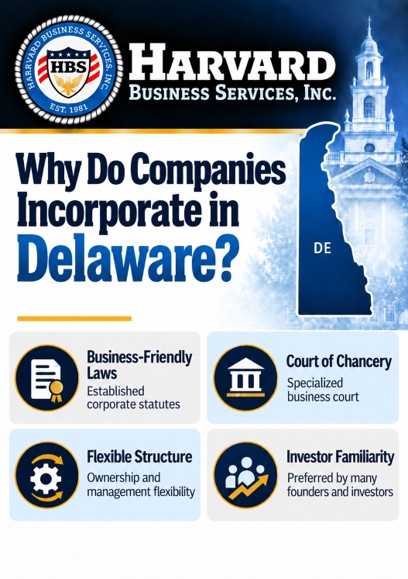 TLDR: Companies incorporate in Delaware because of its well-established corporate laws, specialized Court of Chancery, flexible business structures, and familiarity among investors. Delaware can be especially attractive for startups seeking venture capital, but businesses operating in another state may face additional registration and compliance costs.
Delaware has built a global reputation as a leading jurisdiction for business formation. For founders asking, “Why do companies incorporate in Delaware?”, the answer is not based on one single benefit. Companies of all sizes choose Delaware because of its established corporate laws, specialized court system, flexible business structures, and familiarity among investors.
Delaware’s Corporate Laws and Court of Chancery
One of Delaware’s biggest advantages is its well-developed body of business law, including the Delaware General Corporation Law (DGCL). Delaware also has a specialized business court called the Court of Chancery. The Court of Chancery is a court of equity, where cases are decided by judges rather than juries. These judges regularly handle complex business matters.
Over many years, this has created a large body of established case law. Businesses, attorneys, and investors can often better understand how Delaware law may apply to a corporate dispute because similar issues have been addressed before. That predictability is especially valuable for larger companies and businesses planning to raise outside capital.
Take the first step to being your own boss!
We make it quick and easy to form your Delaware LLC.
Start my business
Tax and Business Structure Advantages
Delaware offers several tax-related features that can be appealing depending on where and how a company operates. For example, Delaware does not impose a state sales tax. Companies formed in Delaware but conducting business elsewhere generally do not pay Delaware corporate income tax on income earned outside the state. However, incorporating in Delaware does not automatically eliminate taxes in the state where a company actually operates. Businesses may still have tax and reporting obligations in other states.
Delaware also provides significant flexibility in how corporations and LLCs are structured. Depending on the entity type, businesses may have flexibility regarding ownership, management, stock classes, and internal governance.
Why Investors Often Prefer Delaware Corporations
Delaware is particularly popular with startups that expect to raise venture capital. Many venture capital firms and institutional investors are familiar with Delaware corporate law and the rights available to shareholders under the DGCL. Delaware corporations can also create multiple classes of stock, which is often important when issuing preferred shares to investors.
For founders planning to seek substantial outside investment, forming a Delaware C Corporation can help create a structure that many investors already understand. A Delaware LLC may be more appropriate for other businesses, including closely held companies, holding companies, or founders who value flexible internal management.
Do You Have to Live in Delaware?
Business owners do not have to live in Delaware to form a Delaware LLC or corporation. However, every Delaware company must maintain a Registered Agent with a physical address in the state. The Registered Agent receives official legal and state correspondence on behalf of the business.
Harvard Business Services, Inc. provides Delaware Registered Agent services and can also help entrepreneurs form Delaware LLCs and corporations.
How to Form a Delaware Company
Forming a Delaware company generally involves:
- Choosing an available business name and entity type.
- Appointing a Delaware Registered Agent.
- Filing formation documents with the Delaware Division of Corporations.
- Maintaining ongoing state and compliance requirements after formation.
For entrepreneurs who decide Delaware is the right fit, Harvard Business Services, Inc. can help simplify the formation process. You can form a Delaware LLC or corporation through HBS and use HBS as your Delaware Registered Agent to help keep your company in compliance.
Take the first step to being your own boss!
We make it quick and easy to form your Delaware LLC.
Start my businessFrequently Asked Questions
Is Delaware better for LLCs or corporations?
Delaware can work well for both. Corporations are often chosen by startups seeking venture capital, while LLCs may appeal to owners who want flexible management and operating structures. The better choice depends on the company’s goals, ownership, and funding plans.
What is the Delaware General Corporation Law?
The Delaware General Corporation Law, commonly called the DGCL, is the main statute governing Delaware corporations. It is known for giving companies flexibility in governance, stock structure, and shareholder rights.
Do Delaware companies have annual compliance requirements?
Yes. Delaware companies must meet ongoing state requirements, which can include annual franchise tax payments, annual reports for corporations, and maintaining a Delaware Registered Agent. Staying current on these obligations helps keep the company in good standing.
*Disclaimer*: Harvard Business Services, Inc. is neither a law firm nor an accounting firm and, even in cases where the author is an attorney, or a tax professional, nothing in this article constitutes legal or tax advice. This article provides general commentary on, and analysis of, the subject addressed. We strongly advise that you consult an attorney or tax professional to receive legal or tax guidance tailored to your specific circumstances. Any action taken or not taken based on this article is at your own risk. If an article cites or provides a link to third-party sources or websites, Harvard Business Services, Inc. is not responsible for and makes no representations regarding such source’s content or accuracy. Opinions expressed in this article do not necessarily reflect those of Harvard Business Services, Inc.